Type">
Goden
Gods
Lees deze text in 
Introduction
Offerings in water
In both the Late Iron Age and the Roman period, people believed
in gods and goddesses who ensured day to day life ran smoothly. We do
not know the names of the gods worshipped in the Late Iron Age, as
there are no written sources from that period. We do however know that
people made offerings to the gods. Rivers were particularly popular as
votive sites. People threw weapons and other objects in rivers as an
offering to the gods. A great deal of this type of material has been
dredged up at Kessel and Lith in the river area, for example. Human
bones have even been found there, and it is likely they found their way
into the water as offerings to the gods. In the north of the country,
too, wet sites were popular places to make offerings. Many such finds
have, for example, been made in the peatlands of Drenthe.
Old and new gods
In the Roman period, the indigenous people were introduced to other
gods. The Roman authorities were very tolerant in matters of religion
in the regions they conquered. People were largely allowed to uphold
their own religion, provided this did not hamper their assimilation
into or disrupt the order in the Roman empire. The Romans also brought
their own gods to the new parts of the empire. They had gods of
weather, vegetation, happiness, prosperity, fertility, death, war and
many other aspects of life. Most gods covered several different things.
Mars, for example, was the god of war, and also the god of fertility
and vegetation. The Roman gods were popular in the towns, where many
people from outside the region lived. Rural areas, on the other hand,
were almost entirely populated by indigenous people, who were reluctant
to give up their traditional habits, customs and values. They made
clear choices, adopting some elements of Roman culture that fitted into
their way of life.
A god with a double identity
In the Roman period, indigenous gods often acquired a double identity.
For example, the Roman hero and demi-god Hercules was associated with
the indigenous god Magusanus, creating a new god with a
double-barrelled name: Hercules Magusanus. Both Hercules and Magusanus
probably played a similar role in society. Gods with double identities
in the northwestern provinces tended to be associated with Mars or
Mercury, though the names Hercules, Apollo and Silvanus also occurred.
Hercules clearly enjoyed great popularity in the north of Germania
Inferior, while further to the south Mars was a more likely choice.
This was probably due to the character of the regions. In the
Mediterranean world Mars was associated with the protection of large
arable farms and vineyards, and so was well-suited to the lifestyle of
the southern farmers. Hercules, the protector of shepherds, would have
appealed more to the people further to the north whose livelihood was
stockbreeding. So it appears that the indigenous population made
conscious choices as to which Roman gods to adopt as their own.
Integration
The process of equating a Roman god with an indigenous divinity
is often referred to by the Latin term interpretatio Romana. We know
this term from the writings of the Roman author Tacitus in which he
described the gods worshipped by the Germans and compared them with the
Roman gods known to his Roman readers. It is generally assumed that
Romans actually made the links between indigenous and Roman gods to
make their rule seem more acceptable. However, an equally plausible
theory is that the link was made by indigenous magistrates or priests
associated with the main regional cult. They held positions of power
among their own people and had the most contact with their Roman
rulers. By forging a link between their own gods and those of the
Romans, they would show their willingness to adapt to Roman rule,
without entirely relinquishing their own religious traditions.
Evidence of indigenous gods
Written covenants
The Romans introduced writing to the Netherlands. It is quite
possible that the gods of the Late Iron Age were still worshipped in
the Roman period. We cannot verify this, however, since we only know
names from the Roman period. Writing played a role in cults, as
indigenous people to some extent adopted the Roman custom of setting up
a votive altar when a god had looked after you well. Covenants were
made between the deity and the believer. If the deity provided the
favours requested, the believer would make an offering in return. The
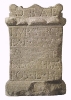
wealthy would set up a votive altar with an inscription stating that
they had kept their promise. Votive altars always bear the name of the
god, and usually also the name and position of the person who had
dedicated it. Some votive altars were set up by people from other
regions – soldiers, veterans or merchants – making offerings to the
gods here. Some were gods familiar to them in their home region, but
alien to these parts. For instance, citizens and sailors from the
Tongeren region made offerings to the goddess Viradecdis and a tribune
from the thirtieth legion left behind a temple and a votive altar
dedicated to the goddess Iseneucaega. It is not known whether these
goddesses, who were worshipped by people from other regions, were also
worshipped by the local population.
Indigenous names
 A
number of the known names of gods are clearly linguistically
indigenous. For example, we know the names Hludana, Baduhennae and
Exomna from historical sources and inscriptions. Other examples include
Haeva, Sandraudiga, Nehalennia, the Mopates and the Aufaniae.
Notably, almost all the indigenous names we know today refer to
goddesses. In the Roman period many of them were given the Latin suffix
Dea (‘goddess’). The gods with a ‘double-barrelled’ name, such as
Hercules Magusanus, which are therefore also partly indigenous, were
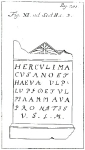
all male. One unique find is an altar that a Batavian couple dedicated
to two deities: the god Magusanus and the goddess Haeva, who may have
been married in Batavian mythology.
Warriors and soldiers
Apart from the written sources, offerings give us most of our
information about the deities worshipped at the time. The
indigenous-Roman god Hercules Magusanus, for example, clearly had some
association with war, as strongly evidenced by the link with Hercules,
an icon for warriors in the Roman world. At the temple in Empel,
furthermore, many items of military equipment have been found. Hercules
Magusanus appears to have been popular among soldiers in the Roman
army. The soldiers probably came from these parts, as offering weapons
to the gods was not common practice in the Roman army. It had however
long been a custom among the indigenous population of what is now the
Netherlands. Many recruits in the Roman army were drawn from the
population groups along the Rhine, including the Batavians. An
inscription on a bronze plaque from the shrine at Empel tells how
Iulius Genialis, a veteran of the 10th legion, left a votive offering
there, probably along with the inscribed plaque.
Depictions of the gods
Indigenous gods
A human form
The indigenous population rarely, if ever, produced depictions
of their gods. This changed when the Romans arrived, however, as people
adopted the Roman practice of representing gods in human form. The
votive altars to indigenous gods and goddesses found in the Netherlands
often only have inscriptions. The few images found have been largely
adopted from Roman sculpture, giving the indigenous gods a typically
Roman appearance. Shown in human form, they could be recognised by the
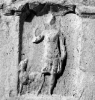
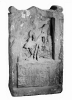
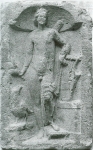
attributes associated with them. The goddess Iseneucaega (or Seneucaega
– the text is almost illegible) was for example depicted in a short
tunic with a quiver on her back, from which she is extracting an arrow.
Beside her stands a dog. This image strongly resembles depictions of
the Roman goddess Diana. The altar bearing the image, which was found
during clay extraction work near Tiel, was erected by Ulfenus, son of
Publius, tribune of the 30th legion. According to the inscription on
the altar, Ulfenus kept his promise to the goddess by building an
entire temple from the ground up in AD 222. Unfortunately, the temple
in question has not (yet) been found.
Altars erected by sailors
The goddess Nehalennia appears frequently on the dozens of votive
altars dedicated to her along the coast of Zeeland in the second and
third centuries. Merchants and sailors from far and wide sought her
favour there, asking her to guarantee them safe passage over the stormy
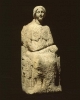
North Sea. She is almost always depicted with a basket of fruit by her
side or in her lap, symbolising fertility. Sometimes she has a horn of
plenty in her hand, a symbol of wealth and prosperity. She herself is
seated on a chair. She sometimes holds a ship’s rudder in her hand,
symbolising her role as the protector of sailors. To one side stands a
large basket of fruit, while a dog usually sits on the other side.
Unlike Iseneucaega, for example, she did not resemble the gods from the
Roman Pantheon. Her appearance is more reminiscent of the ancestral
mother goddesses who were worshipped around Cologne and in other areas.
A cockerel for Arcanua
No depictions of the goddess Arcanua have been found. Her name is known
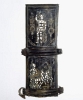
from two inscriptions found at a single findspot. One was on the base
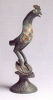
of a bronze figurine of a cockerel, which might have been an attribute
of the goddess. Words have been scratched on the base: ‘DEAE ARCANVE
VLPIVS/VERINVS VERTERANVS LEG VI V.S.L.M.’, which translates as:
‘Ulpius Verinus, veteran of the sixth legion, hath willingly and with
reason kept his promise to the goddess Arcanua’. The cockerel’s back is
hollow, perhaps suggesting that it was used as a candleholder or oil
lamp. The bird’s breast, comb and eyes are enamelled, making it a
colourful object. More of these cockerels have been found in the
Rhineland, though none had an inscription.
Gods with a double-barrelled name and
Roman gods
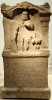
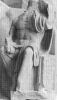
A Frenchman in the Netherlands
We also know very little about the appearance of the more Roman
gods. One of the few gods of whom images have been found is Mercurius
Arvernus. He is shown on a votive altar built into a church wall in
Horn (Limburg). Its original position is unknown, though it undoubtedly
comes from a shrine in the close vicinity. Mercurius Arvernus was
probably a god of the Arverni people, who lived in the Auvergne of
present-day France. The altar was erected by Irmidius Macro, about whom
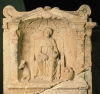
we know nothing else, unfortunately. On the upper part of the votive
altar Mercurius Arvernus is shown sitting in a niche. A cloak hangs
over his left shoulder and arm and falls over his left leg. He holds a
staff with serpents (a ‘caduceus’) in his left hand, and probably a
purse in his right hand, which may indicate Mercury’s role as the god
of trade. Behind him, a he-goat lies on the ground. The sides of the
altar are also decorated with reliefs. Below the central image is an
inscription which has unfortunately sustained some damage. The text
probably reads: ‘Irmidius Macro hath dedicated (this) temple to
Mercurius Arvernus at his command’. It must therefore have stood in or
near a temple.
God of the Batavians
A number of images of Hercules Magusanus, chief god of the Batavians,
have been found. It would appear that this god, despite his indigenous
origins, was depicted in entirely the same way as the Roman god
Hercules. Two votive altars from Bonn from the second half of the
second century and first half of the third century show Hercules
Magusanus as Hercules with a club on which he leans with his right
hand. A lion’s skin hangs over his left arm, and his right hand holds
the apples of the Hespirides. One of the stones from Bonn also shows
the hell hound Cerberus. The back of emperor Postumus’ coins also shows
an image of Hercules Magusanus. Here, too, he is depicted as Hercules,
leaning on a club, with apples in his right hand behind his back – a
popular representation of Hercules in the Mediterranean region. A
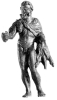
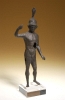
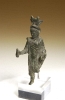
figurine of Hercules with a lion skin, probably a club and a drinking
cup in his hand, was found at the temple in Empel, the only shrine that
can be directly attributed to Hercules Magusanus. All the depictions
refer to myths about Hercules that were widely known in the Roman
empire and which had clearly merged with the myths surrounding the
indigenous god Magusanus.
Figurines of the gods
Statues and figurines of other Roman gods have also been found
in Empel and elsewhere. Most were made of bronze, though pottery
figurines of a number of goddesses have also been found, generally in
graves. It is not entirely clear how we should interpret these
figurines of Romans gods, as we know little about religion and
religious practices in the Roman Netherlands.
Special forms of veneration
 Several
fragments of ‘Jupiter Columns’ have been found in the Netherlands. They
were erected in honour of the chief god of the Romans, usually by
private citizens. A statue of Jupiter would crown the column. Jupiter
Columns stood in towns and rural centres, and above all in the
countryside and at villae. They were particularly common in both
Germanic provinces, occurring also in Gallia Belgica and, sporadically,
in other Gallic provinces. In the Netherlands most fragments of Jupiter
Columns come from southern Limburg, though pieces have been found
elsewhere, including Valkenburg (Zuid-Holland province). Indeed, a
fairly large number of fragments have been found in Nijmegen.
Jupiter-giant Column
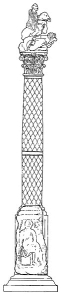
There were various types of Jupiter Column, with the most striking
difference being found in the statue of Jupiter topping the column. A
Jupiter-giant Column would show Jupiter on horseback, jumping over one
or more giants (mythical beasts with serpents for legs). In another
type common in Germania Inferior, Jupiter is seated on a throne (like
the statue of Zeus in Olympia). Both types of column also have other
distinctive features. The Jupiter-giant Column, for example, has a
distinctive pedestal with representations of deities (Viergötterstein),
showing Roman gods (usually Juno, Minerva, Hercules and Mercury) on
three or four sides. Above that there was often a second plinth
(octagonal or round) depicting the gods for whom the days of the week
are named. The plinth supported a column that was generally decorated
with a fish-scale pattern. The column was crowned with a capital, on
which figures were often also depicted, perhaps representing the four
seasons, or tussling giants. On top of that would be the statue of
Jupiter on horseback.
The heyday of the Jupiter-giant Column was the late second
century and third century AD. This type of Jupiter Column,
characteristic of Germania Superior and the eastern part of Gallia
Belgica, would appear to tie in with the indigenous religious practices
of the Celts. It is particularly common in the civitas Tungrorum, the
capital of which was Tongeren in present-day Belgium. The same applies
to Maastricht, which was probably also part of the Tongeren civitas.
Several fragments – parts of a column with a fish-scale pattern, at
least three Viergöttersteine, and also a large capital with
personifications of the four seasons – have been found in Maastricht,
although the columns cannot all be completely reconstructed. The most
impressive Viergötterstein found on Dutch soil is an almost metre-high
pedestal from Kessel (Limburg) with reliefs of Juno, Minerva and
Hercules. One of the most important examples of the equestrian group
that topped the column was found in Tongeren.
Jupiter Columns from Germania Inferior
The Jupiter Column from Germania Inferior was simpler than the
Jupiter-giant Column, and probably also smaller. The column supported a
statue of Jupiter seated on a throne. Unlike the equestrian version, it
did not usually have a Viergötterstein as its base. However, there
would often be three depictions of gods one above the other on the
column, giving it a distinctive front and back. The column itself was
usually decorated with fish-scales, like the versions with the giants,
although smooth columns are also known. This type of column occurred
mainly in the civitas Ubiorum, around the capital Cologne and elsewhere
in Germania Inferior. A fairly large number of fragments of Jupiter
Columns have been found in the Roman city of Nijmegen. There, three
statues of an enthroned Jupiter have been found, as well as one unique
variation: a standing Jupiter wrestling a giant. The Nijmegen columns,
including parts of the column with the scale pattern and depictions of
gods, probably date to the late second and early third centuries.
Another notable group of finds comes from Grevenbicht (in southern
Limburg), where three statues of an enthroned Jupiter and remains of
columns have been found. The Jupiter Columns from Grevenbicht were
found at a villa site. This type of column had its heyday at the same
time as the Jupiter-giant Column, in the late second century and third
century AD.
Votive pillars
Monumental
votive pillars are related to Jupiter Columns. However, they were not
‘columns’
(monolithic and round in cross section), but ‘pillars’ (constructed in
sections
and square in cross section). Like Viergöttersteine,
which might have reliefs of the gods on four sides, the pillars had
several
stages bearing images of the gods.
One of the
earliest known votive pillars stood in the oldest Roman town in the
Netherlands: Oppidum Batavorum near Nijmegen. This is the earliest and
most
important example of Roman sculpture ever found in the Netherlands. The
Nijmegen votive pillar must have been erected around AD 17 as a
monument
commemorating the Roman army’s victories in the name of emperor
Tiberius. It
supported a statue not of Jupiter, but of the emperor himself. While
not a Jupiter
Pillar in the sense that its successors were, this monument – which
stood some
7.5 metres high, including the statue of the emperor standing – might
well be
regarded as an early stage in the development of the type.
In Maastricht
the remains of a colossal Jupiter Pillar have been found dating from AD
138-180. It stood almost ten metres high, including the statue of a
standing
Jupiter, which is more than life-sized. The pillar itself was made of
blocks of
limestone with gods carved on all sides. In terms of its size and
execution,
this was an exceptionally monumental pillar, and probably served as an
example
for Jupiter Columns for many miles around. Although this type of
monument
differs significantly from the known Jupiter Columns with an enthroned
Jupiter
and Jupiter-giant Columns, it has to be regarded as part of the same
group, and
indeed it was made in the same period. The type of stone used and its
extraordinary artistic quality mean this pillar was almost certainly
commissioned by the Roman authorities. It was found in a Roman temple
complex
below what is now Hotel Derlon. The base of the pillar is still in its
original
position, and can be seen at Museumkelder
Derlon.
Summary
Old gods
In both the Late Iron Age and Roman period people worshipped
gods and goddesses who ensured day to day life ran smoothly. We do not
know the names of the Late Iron Age gods, as there are no written
sources from that period. We do however know that people made offerings
to the gods. Rivers and other wet sites were particularly popular sites
for offerings. The Roman authorities were very tolerant of religion in
their newly conquered territories. The people were in large measure
allowed to stick to their own beliefs, provided this did not hamper
their assimilation into or disrupt the order in the Roman empire. Many
finds have provided evidence that indigenous gods were still worshipped
in the Roman period.
Worshipping gods
The arrival of the Romans added a new dimension to the religion
of the indigenous people, as they adopted the Roman practice of setting
up votive altars to the gods who took care of them. The altar would
bear an inscription, and often also an image of the deity in question.
As a result, we known the names of some indigenous gods and goddesses
and some of the people who worshipped them. Goddesses, in particular,
appear to have retained their indigenous name, with the Roman suffix
‘Dea’ (‘goddess’) simply being added. One example is the goddess
Nehalennia, who was worshipped along what is now the coast of Zeeland.
Several male gods were linked to a Roman god who had the same
‘function’. The god Magusanus, for instance, who was probably venerated
in the Late Iron Age with offerings of weapons and other objects, was
linked to the Roman demi-god Hercules. He was an icon to Roman
warriors, and was therefore well-suited to the indigenous Magusanus.
Hercules Magusanus was popular among soldiers in the Roman army, who
made offerings of their weapons, presumably after they had finished
their military service. Many pieces of military equipment have been
found in the river near the Roman temple at Empel. The offering of
weapons and equipment was an indigenous custom that was unknown among
the Romans. The military followers of Hercules Magusanus were probably
therefore soldiers from Dutch territory.
Depictions of gods
The Romans also introduced the practice of depicting gods in
human form, and votive altars have also revealed to us some images of
indigenous-Roman gods. Notably, depictions of gods appear largely,
though not exclusively, to be derived from Roman mythology. The goddess
Iseneucaega, for example, strongly resembles the Roman goddess Diana,
while Hercules Magusanus was depicted as the Roman Hercules, with all
the attributes belonging to him, according to Roman lore. We also have
images of gods worshipped in the Roman Netherlands from the widespread
finds of bronze and pipe clay figurines.
Columns for Jupiter
Jupiter Columns, erected in honour of the Romans’ chief god,
have been found in both Germania Inferior and Germania Superior, and in
Gallia Belgica and regions further to the south. Representatives of
this type of monument have also been found in the Netherlands. These
tall columns supported a statue of Jupiter. In the version most
commonly found around Cologne and elsewhere in Germania Inferior,
Jupiter is seated on a throne. The other version is known as a
Jupiter-giant Column, after the giants (mythical beasts with serpents
for legs) over which Jupiter jumps astride his horse. Jupiter-giant
Columns are common in the region around Tongeren in Belgium, which also
includes Maastricht.
Votive pillars
Votive pillars are related to Jupiter Columns. These four-sided
pillars were decorated all over with images of gods. One of the
earliest known votive pillars, a monument commemorating the Roman
army’s victories, was found in Nijmegen. It supported a statue of the
Roman emperor. The Maastricht Jupiter pillar at Derlon is a later
example, from the mid-second century. The foundations of a Jupiter
pillar, almost ten metres high, were found inside the surrounding wall
of a temple complex. A statue of a standing Jupiter crowned the pillar.
Margje Vermeulen-Bekkering
Met dank aan dr. T.
Derks en dr. T.A.S.M. Panhuysen
References
General:
Derks, T.,
1998, Gods, Temples and
Ritual Practices.
The transformation of
religious ideas and values in roman Gaul.
(Amsterdam
Archaeological Studies 2).
Amsterdam
Es, W.A. van, 1981, De Romeinen in
Nederland. Bussum.
Verhart, L., 2006, Op zoek naar de
Kelten. Nieuwe
archeologische ontdekkingen tussen Noordzee en Rijn. Utrecht.
Findspots in the Netherlands:
Roymans, N. en T, Derks (ed.)1994, De tempel van Empel. Een
Hercules-heilgdom in het woongebied van de Bataven. (Graven naar het
Brabantse
verleden 2) ’s-Hertogenbosch.
Schegget, M.E.
ter, 1999, Late Iron Age human
skeletal remains from the river Meuse at
Kessel: a river
cult place? In: F. Theuws & N. Roymans, Land and ancestors :
cultural dynamics
in the
Urnfield period
and the Middle Ages in the Southern Netherlands.
Amsterdam.
Zee, K., 2005, Religie. In: W.J.H. Willems et al.
(ed.),
Nijmegen. Geschiedenis van de oudste stad van Nederland. Wormer 185-198
Jupiter Columns:
Noelke, P., 1981,
Die Iupitersäulen und –pfeiler in der römischen Provinz
Germania
inferior. In:
G. Bauchhenss & P. Noelke, Die Iupitersäulen in den
germanischen Provinzen,
Köln/Bonn.
Panhuysen, T.A.S.M., 1996, Romeins Maastricht en
zijn
beelden. Maastricht/Assen
Panhuysen, T.A.S.M., 1997, Der grosse Iuppiterpfeiler von Hotel
Derlon in
Maastricht. Situla
36, 183-196.
Panhuysen, T.A.S.M., 2001, Mosae Traiectum / Maastricht. Eine
grabtypologische und
ikonographische Fundgrube. In: T.A.S.M. Panhuysen (Hrsg.), Die
Maastrichter
Akten des 5. internationalen
Kolloquiums über das provinzialrömische Kunstschaffen (im
Rahmen des
CSIR). Typologie,
Ikonographie und soziale Hintergründe der provinzialen
Grabdenkmäler und Wege
der ikonographischen Einwirkung. Maastricht 29. Mai bis 1. Juni
1997. Maastricht, 17-34.
Panhuysen, T.A.S.M., 2002, De Romeinse godenpijler van
Nijmegen-Kelfkensbos. De Navel van Nijmegen? Museumstukken 8. Nijmegen
Links
General:
Archeologienet
Cultuurwijzer
Limes.nl
Imperium Romanum (German)
Livius.org (English)
Maastricht:
Museumkelder
Derlon.