
Siehe diesen Text auf
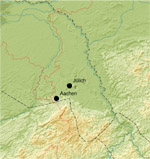
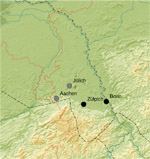
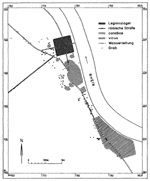
Securely identifiably small towns were rare in southern Lower Germany until the mid 1st century AD. Moreover, the development of some two to four settlements that are of this early period was heavily influenced by the military. The thermal springs of Aachen were initially used as a spa for Roman soldiers, while the spending power of the soldiers determined the development of the settlement south of the legionary fortress Bonn and the neighbouring canabae.
 |
 |
 |
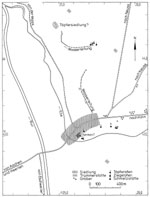
A marked gear change in the development of small urban sites is noticeable in the second half of the first century. Amongst the four new foundations of the period is Stolberg-Breinigerberg, where the finds suggest initial settlement just before the end of the century, but the zinc deposits in the surrounding area were continuously mined from the LaTène Period onwards. It, thus, cannot be ruled out that earlier predecessor settlements in the vicinity of Stolberg-Breinigerberg remain to be discovered.
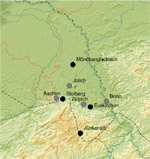
Unlike southern Germany, Lower Germany did not see an advance of the frontier and so only few small towns developed from early vici. Amongst these are Moers-Asberg and Neuss, which the military left at the beginning of the 2nd century AD, but where the vicus or rather the canabae legionis continued as civilian settlements. No new small town foundations are known from the second half of the 2nd century.
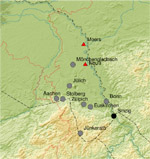
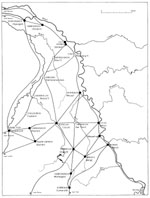 In southern Lower Germany, as elsewhere, the many small towns lay at the
intersections of long-distance roads. A particularly important crossroads settlement
was Jülich (Iuliacum), where the north-south road linking Trier with Nijmegen
met the east-west road from Cologne, via Tongeren, to Bavai. Other small towns
lay mostly along one of the main highways, and where linked via secondary road
with the other axis.
In southern Lower Germany, as elsewhere, the many small towns lay at the
intersections of long-distance roads. A particularly important crossroads settlement
was Jülich (Iuliacum), where the north-south road linking Trier with Nijmegen
met the east-west road from Cologne, via Tongeren, to Bavai. Other small towns
lay mostly along one of the main highways, and where linked via secondary road
with the other axis.
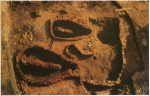 Of the southern Lower German small towns which have so far been at least
partially excavated, the majority derived their income first and foremost from
trade: for example Mönchengladbach-Mülfort, Neuss (Novaesium), Jülich (Iuliacum),
Zülpich (Tolbiacum), Euskirchen-Billig (Belgica), Bonn and Jünkerath (Icorigium).
As elsewhere craftsmen, especially smiths and potters, settled in these towns
and covered the everyday needs of the population.
Of the southern Lower German small towns which have so far been at least
partially excavated, the majority derived their income first and foremost from
trade: for example Mönchengladbach-Mülfort, Neuss (Novaesium), Jülich (Iuliacum),
Zülpich (Tolbiacum), Euskirchen-Billig (Belgica), Bonn and Jünkerath (Icorigium).
As elsewhere craftsmen, especially smiths and potters, settled in these towns
and covered the everyday needs of the population.
Only three settlements owe their existence to other economical conditions. The presence of thermal springs at Aachen (Aquae Granni) led to the development of a spa town. Nearby Stolberg-Breinigerberg appears to have been a mining town, whose inhabitants derived their income from mining zinc ore (Galmei), an important ingredient in the manufacture of brass. Finally, potters from Trier made Sinzig (Sentiacum) a centre of Samian ware manufacture in the mid third of the second century AD.
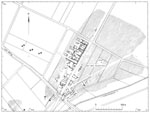
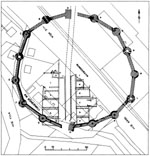
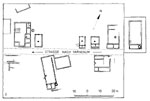
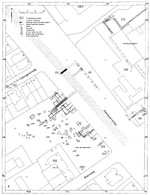
Only three of the small towns in the German part of the Roman province of Germania Inferior have seen large scale excavations. But all of these settlements, Euskirchen-Billig (Belgica), Jünkerath (Icorigium) and Stolberg-Breinigerberg show the typical arrangement of two rows of houses along the main roads which is typical in the Dutch part of the province, and in northern Upper Germany. As far as is currently known, the civilian settlement in Bonn-Regierungsviertel showed a similar building pattern but it is not yet possible to say, how deep the plots were and whether or not there may have been insula style occupation similar to Walheim in Upper Germany.
 |
 |
 |
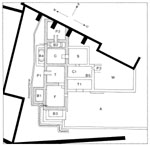
Few public buildings have so far been excavated in the small Roman towns of southern Lower Germany. Only at Zülpich (Tolbiacum) has it been possible to excavate a multi-period bath house, although scant remains of a baths have survived at Jülich (Juliacum). No public baths could be identified at Euskirchen-Billig (Belgica), despite large-scale excavations, but there are rectangular buildings close to the large road fork, whose long axes lie parallel to the road and thus deviate from the usual ground plan. These structures may have had some public function, but the exact purpose they served, remains unclear.
 |
|
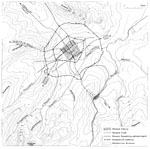
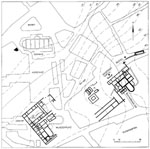 Aachen (Aquae Granni) had two large thermal complexes: the Münsterthermen
in the west and the Büchelthermen in the east, both of which adjoined a large
walled complex with Gallo-Roman temples, possible a sanctuary of Apollo-Grannus.
Aachen (Aquae Granni) had two large thermal complexes: the Münsterthermen
in the west and the Büchelthermen in the east, both of which adjoined a large
walled complex with Gallo-Roman temples, possible a sanctuary of Apollo-Grannus.
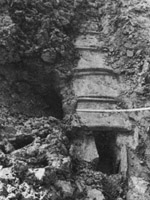
In most of the small towns the residents used wells at the back of their houses as their source of water, but at Jülich (Iuliacum) and Mönchengladbach-Mülfort, the remains of pipes suggest an additional water supply. Pipes are also known from Aachen (Aquae Granni) and an aqueduct brought drinking water and the water needed at the Büchelthermen from the hills to the south. The Münsterthermen were supplied from the on-site thermal springs.
 |
 |
 |
The houses were all timber-framed. At Jünkerath and Zülpich they were initially post-built or cill-beam structures but, at a later point these timber-framed houses acquired stone dwarf walls. The floors were made of clay or simple mortar. Hypocausts were rare and, to date, are only known from the vicus in Bonn.
|
|
 |
Jülich:
P. J. Tholen, Iuliacum – Jülich. Bonner Jahrb. 175, 1975, 233 ff.
J. Kleeman, Ein wiederentdeckter römischer Töpferofen in Jülich. Archäologie
im Rheinland 1992 (Köln 1993) 61 ff.
F. Wetzels, Streifenhäuser im römischen Jülich. Archäologie im Rheinland 1998
(Köln 1999) 60 ff.
Bonn:
J.-N. Andrikopoulous-Strack, Der römische Vicus von Bonn. Bonner Jahrb. 196,
1996, 421 ff.
Dies., Der römische Vicus von Bonn. In: Geschichte der Stadt Bonn 1. Bonn von
der Vorgeschichte bis zum Ende der Römerzeit (Bonn 2001) 199 ff.
Zülpich:
H. G. Horn, Das römische Zülpich. Führer zu vor- und frühgeschichtlichen Denkmälern
26, Teil 2 (Mainz 1974) 25 ff.
Ders., Das Römerbad in Zülpich. Führer zu vor- und frühgeschichtlichen Denkmälern
26, Teil 2 (Mainz 1974) 30 ff.
T. Grünewald, Chlodwig und die „Schlacht bei Zülpich“. Ausstellung in Zülpich
1996, 11 ff.
M. Dodt, Die Straßen des antiken Zülpich. Archäologie im Rheinland 1997 (Köln
1998) 73 ff.
T. Ibeling, Eine weitere bebaute Parzelle der Römerzeit. Archäologie im Rheinland
2000 (Stuttgart 2001) 67 f.
Z. Thóth u. Z. Visy, Römische Thermen und Benediktinerpropstei – Ausgrabungen
auf dem Mühlenberg 2001. Archäologie im Rheinland 2001 (Stuttgart 2002) 57
ff.
Euskirchen-Billig:
H. v. Petrikovits, Belgica (Euskirchen-Billig). Führer zu vor- und frühgeschichtlichen
Denkmälern 26, Teil 2 (Mainz 1974) 142 ff.
Ders., Kleinstädte und nichtstädtische Siedlungen im Nordwesten des römischen
Reiches. In: H. Jankuhn, R. Schützeichel u. F. Schwind (Hrsg.), das Dorf der
Eisenzeit und des frühen Mittelalters. Abhandl. Akad. Wissensch. Göttingen.
Philolog.-Hist. Klasse 3. Folge 101 (Göttingen 1977) 86 ff.
W. Wegener, Zitronensäurelösliches Phosphat als Siedlungsindikator am Beispiel
des römischen vicus bei Billig. Archäologie im Rheinland 1988 (Köln 1989) 59
ff.
Jünkerath:
H. Koethe, Straßendorf und Kastell bei Jünkerath. Trierer Zeitschr. 11, 1936,
Beih. 1, 46 ff.
W. Binsfeld, Jünkerath. Führer zu vor- und frühgeschichtlichen Denkmälern 33
(Mainz 1977) 300 ff.
Mönchengladbach-Mülfort:
In: Ausgrabungen, Funde und Befunde 1990. Bonner Jahrb. 192, 1992, 384 f.
C. Weber, Römische Töpferöfen in Mönchengladbach-Mülfort. Archäologie im Rheinland
1992 (Köln 1993) 63 ff.
Stolberg-Breiningerberg:
M. Schmidt-Burgk, Zeitschr. Aachener Geschichtsverein 45, 1923, 283.
H. v. Petrikovits, Kleinstädte und nichtstädtische Siedlungen im Nordwesten
des römischen Reiches. In: H. Jankuhn, R. Schützeichel u. F. Schwind (Hrsg.),
das Dorf der Eisenzeit und des frühen Mittelalters. Abhandl. Akad. Wissensch.
Göttingen. Philolog.-Hist. Klasse 3. Folge 101 (Göttingen 1977) 86 ff.