
See this text in
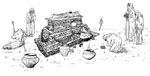 The burial rite of the Roman period reflects some religious notions and ritual
practices of the Germans in the central Danubian area. In the Roman era cremation
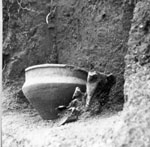
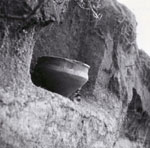
burial rite, i.e. cremation of the deceased was prevalent with a majority of
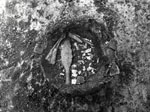
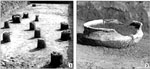
Germanic population. The so-called urn graves have contained burnt
human bones and possible gifts, often damaged by heat. Urn graves without any
burial gifts are not missing either. The so-called pit graves also appear abundantly.
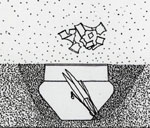
Most often these are smaller circular pits in which traces of placing of the
ashes into organic covers, textile or leather bags were found. With larger
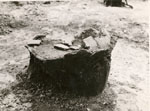
pits of rectangular shapes it is supposed that the cremation was performed
directly above the pit. The burnt remains of the pyre with remains and possible
burial gifts have then sunken into the pit.
The burial rite of the Roman period reflects some religious notions and ritual
practices of the Germans in the central Danubian area. In the Roman era cremation
burial rite, i.e. cremation of the deceased was prevalent with a majority of
Germanic population. The so-called urn graves have contained burnt
human bones and possible gifts, often damaged by heat. Urn graves without any
burial gifts are not missing either. The so-called pit graves also appear abundantly.
Most often these are smaller circular pits in which traces of placing of the
ashes into organic covers, textile or leather bags were found. With larger
pits of rectangular shapes it is supposed that the cremation was performed
directly above the pit. The burnt remains of the pyre with remains and possible
burial gifts have then sunken into the pit.
 |
 |
 |
 |
 |
 |
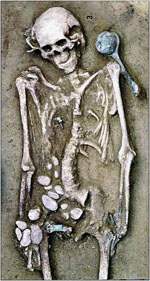
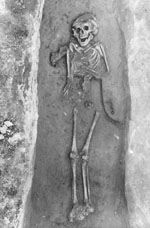
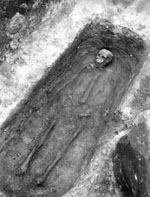
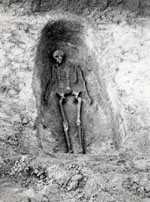
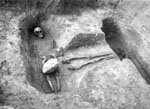
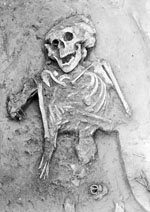
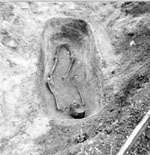
To a smaller extent the deceased were placed non-cremated into so-called skeleton graves. From the territory under observation we are only aware of several dozens. It is assumed that persons of social importance have been laid to rest into these (as in the case of the princely graves at Mušov and Zohor), and also foreigners or persons otherwise differing from the majority population. Archaeology also sometimes discovers the so-called biritual burial grounds (e.g. Abrahám, Kostolná pri Dunaji, Mikulov, Velatice), at which both cremation and skeleton rites were practised simultaneously. According to the testimony of some Germanic biritual necropoli from the territory of Slovakia, at which archaeological excavations have been carried out on most of their area, it seems that the skeleton graves have made up integrated groups. From the hitherto inapprehensible, deeper cultural, ethnical or social reasons these have differed from the surrounding cremation graves.
 |
 |
 |
 |
 |
 |
 |
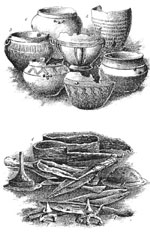 A part of the burial rite was placing of grave gifts into the graves.
A majority of common cremation graves was equipped with one or two pottery
vessels, a brooch or other adornment, a knife or a whorl. Most often these
were personal items of the deceased person, and in some cases it cannot be
excluded that these items were produced specifically for the purpose of placing
into the grave. The grave gifts are often found scorched and intentionally
distorted. The deformations apparently related with the posthumous concepts
of the then Germans have mostly affected bronze vessels and weapons, which
were often placed outside of the urn. A possible reason for an intentional
damage might also been the endeavour that these items were not possible to
be unearthed at a later date to be used again. The grave gifts comprised items
difficult to be ascertained by archaeology, a certain quantity of food that
was given to the dead into their graves for the obituary journey, and other
items from organic materials. However, urn graves and very poor pit graves without any gifts are also numerous.
Contrary to settlement wholes the finds from the graves are capable of a relatively
precise temporal classification; hence their immense importance for the cognition
of the development of the Germanic populations of the Roman period.
A part of the burial rite was placing of grave gifts into the graves.
A majority of common cremation graves was equipped with one or two pottery
vessels, a brooch or other adornment, a knife or a whorl. Most often these
were personal items of the deceased person, and in some cases it cannot be
excluded that these items were produced specifically for the purpose of placing
into the grave. The grave gifts are often found scorched and intentionally
distorted. The deformations apparently related with the posthumous concepts
of the then Germans have mostly affected bronze vessels and weapons, which
were often placed outside of the urn. A possible reason for an intentional
damage might also been the endeavour that these items were not possible to
be unearthed at a later date to be used again. The grave gifts comprised items
difficult to be ascertained by archaeology, a certain quantity of food that
was given to the dead into their graves for the obituary journey, and other
items from organic materials. However, urn graves and very poor pit graves without any gifts are also numerous.
Contrary to settlement wholes the finds from the graves are capable of a relatively
precise temporal classification; hence their immense importance for the cognition
of the development of the Germanic populations of the Roman period.
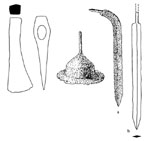
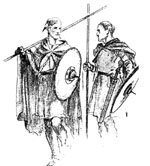
The make up of the gifts in the individual graves has not only reflected the posthumous notions of the deceased but also their social status. Thus it allows for e.g. a differentiation of the graves of ordinary population from the burials of other social groups. The warrior graves containing one or more weapons are important; they also provide the most relevant source to the Germanic warcraft (fig. 16-17). Tips of lances and arrows, sometimes also swords, primarily of Roman origin, or fittings of shields were placed into the graves most often. Rich and exceptionally rich wholes – the so-called princely graves – are attributed to the members of the highest tribal nobility. Sometimes these contain a smaller number of weapons; precious bronze, silver, glass, and pottery items often manufactured in distant areas of the Roman Empire dominate among the grave gifts. The richest princely grave of the early Roman period in the entire European Barbaricum is the princely grave at Mušov.
 |
 |
Burial grounds and grave finds belong to the main source materials for the Roman period. It is the grave finds that provide the best documentation of the development of the Germanic settlement to the north of the middle Danube, and also the intensity of influx of many kinds of Roman products may only be traced in the grave wholes. Admittedly the number of known necropoli in this country is several times smaller than the number of settlements. In most cases the burial grounds were only excavated in parts; therefore the total number of graves ascertained at them definitely does not conform to the reality of the period. Apart from isolated finds medium-sized burial grounds with several dozens of graves dominate in the territory of Moravia and Lower Austria. On larger necropoli, e.g. Šaratice, Modřice u Brna or Kostelec na Hané in Moravia up to several hundreds of graves used to be unearthed. Hitherto we are not aware of any burial ground in this area at which it would be possible to clearly corroborate continuous undertaking throughout the entire Roman period.
More representative unearthings and publications of burial grounds are known from Slovakia, from the Quadian settlement area. In the 1960s extensive archaeological excavations of the Germanic necropoli have been carried out on the southern edge of the fertile Trnava loessal table, in Abrahám, Kostolná pri Dunaji, and Sládkovičovo. These have brought a new perspective of the position of south-western Slovakia in the early Roman period. A marked representation of cremation warrior graves with uncommonly rich occurrences of weapons and luxurious Roman products bear witness to an extraordinary importance of this area within the entire middle Danubian Barbaricum; it allows for considering the central position of the given region within Vannius kingdom. A joint occurrence of both cremation and skeleton graves at the above burial grounds indicates the differences in the social, religious, and perhaps also ethnical make up of the Germanic settlement. Find wholes of a similar value, albeit much less numerous, have also been acquired at the lower course of the Morava River in Vysoká pri Morave and Zohor. In Vysoká pri Morave a grave has been discovered in 1939 containing a skeleton with a west-east orientation and an exceptionally rich grave inventory – inter alia sets for the preparation of mulled and spiced wine and feasting ceremonies. In the 1950s the contents of a few (4 or 5?) graves disturbed by sand extraction were rescued in Zohor; the skeleton graves were similarly equipped with spectacular imports. There were e.g. 19 bronze vessels and 2 silver cups - kantharoi found altogether in these graves. The occurrence of the Germanic pottery testifies for the Germanic citizenship of the interred. All these graves belong in the supra-regional group of the so-called Lubieszewo type (according to the Lubieszewo-Lübsow site), widespread mainly in the northern part of the so-called free Germania in the latter half of the 1st and the 1st half of the 2nd century. Burial of non-cremated bodies (contrary to the common cremation burials), rich imports, and an absence of weapons is characteristic for this type. It represents the highest social status constituent of the Germanic society (chieftains, princes, "kings"). In the 1950s in Očkov close to Piešťany the archaeologists have unearthed a cremation necropolis from the early and late Roman periods that has originally consisted of 1500 graves as a minimum. It is the largest excavated necropolis in Slovakia unearthed to this day. The oldest graves date to the end of the 2nd century, the most recent ones to the beginning of the 5th century. As compared to the burial grounds from the early Roman period the inventory of the graves is markedly more modest. The armour and military equipment are missing in them. The most often find in the urns was a lump of fragrant bitumen, undoubtedly related with the burial ceremonies. Hand-made pottery was used for urns. The wealthier constituent of the inhabitants have gradually started to use more luxurious, wheel-made vessels of vase and bowl shapes as urns. In the late Roman period the "riches" of the burial equipment expressing the social status of the undertaken gradually concentrate in the urn. A proof of this is also the use of a terra sigillata bowl for this purpose. A unique antique alabaster vase functioning as an urn is unparalleled in the entire Europe unoccupied by the Romans. Očkov has undoubtedly been a central necropolis for several habitations near the Dudváh River, mainly for the vast settlements in Pobedim. The highest social stratum of the Germanic settlement agglomeration in the middle Váh area has not cremated their deceased; its skeleton graves were found in the nearby Krakovany-Stráže.
AUCR