Foreigners on French territory in the Merovingian period
France derives its name from a « barbarian » people of Germanic origin, the Franks, whose king Clovis took over northern Gaul after the battle of Soissons in 486, thus ending five centuries of Gallic integration in the Roman Empire. He is the first king of the first French dynasty, the Merovingian dynasty (486-751).
When the Merovingians ruled, France still lacked unity, either cultural or political. The centre of gravity of the kingdom, or the kingdoms, whose number and frontiers fluctuated through the centuries, lay further to the north and east than that of today’s France. The Merovingian kingdom included the whole of Belgium and Luxemburg, as well as part of the Netherlands, Germany and Switzerland. By contrast, Roman (then Byzantine) Corsica, Languedoc-Roussillon (belonging to the Spanish Visigothic kingdom in the 6th and 7th centuries), and Brittany (which takes its modern name from the immigration of Britons then arriving from Britain) were not part of the Merovingian kingdoms.
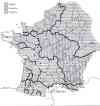
The population of modern France is very diverse in terms of origins, languages, customs and traditions. Regions located north of the river Somme were occupied by the Franks from the middle of the 5th century; the northern part of the Atlantic littoral had also witnessed Anglo-Saxon settlement. In these regions, numerous Germanic immigrant groups mixed with the old Gallo-Roman population. These Germans inhumed or cremated their dead, often providing them with many grave goods.
The regions north of the river Loire constituted the first kingdom of Clovis. Called ‹‹Francia›› or ‹‹Neustria›› since the 6th century, this territory was centered on the Parisian Basin (the region which, in the later Middle Ages, came to be known as « Pays de France » or « Ile-de-France »); it was distinct from the eastern Frankish territories, the ancient kingdom of Cologne, which at the end of the 6th century became ‹‹Austrasia››. North of the Loire, the arrival of a Frankish dynasty does not seem to have been followed by massive ethnic change, though marked Germanic influence can be seen there.
Amongst the late-Roman population, inhumation was well established and the use of grave goods had almost universally disappeared by 400. The Germans displayed new clothing fashions and new customs (the dead were buried fully dressed, with their belts and sometimes their weapons for the men, their jewellery for the women). Some kinds of costume, mostly female, and the way they were worn, belonged to traditional regional dress, enabling us to trace the origin of the deceased. This introduction of new fashions in Gaul can be linked to the political and social prestige of the new rulers and the Frankish aristocracy, as much as to the settlement, mainly in strategic zones, of population groups with very miscellaneous origins. It is indeed striking to see in the same cemeteries of northern Gaul, and sometimes in the same tombs, jewellery from very diverse geographical origins. Indeed the historical interpretation of archaeological finds, especially precise ethnic attributions, still remains quite hazardous.
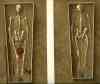
However, big asymmetricalbow-brooches belonging to a new Germanic fashion, of non Gallo-Roman origin, characterize the newcomers well. The number of these brooches – only worn by upper-class women – is quite small: only a few items per site, at most. Moreover, their use dramatically decreased after the middle of the 6 th century. Along with these jewels, most probably made in foreign countries, one can see their local derivatives, made for people of barbarian origin yet firmly established in Gaul.
It is still very difficult, using archaeology, linguistics and toponymy, to assess the importance of the Germanic population. It certainly varied: almost negligible south of the river Seine, more important around the royal domains and the estates of Frankish aristocrats of the Aisne and Oise valleys or Champagne, though the native population remained the majority even there; the percentage of Germanic settlements became important only north of the river Somme and in the east, beyond the Ardennes. It is hard to define a linguistic border, because many Latin-speaking pockets remained in Germanic-speaking regions and vice versa. Bilingualism was probably frequent north of the Seine. However, Germanic languages prevailed only in the north and east of Gaul, beyond the Ardennes and Vosges.
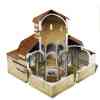
Apart from these peripheral zones, Gaul saw no real cut-off point at the end of Antiquity. Formerly Roman cities slowly evolved without changing location. Written sources show that many foreigners of Mediterranean origin lived there: Syrians, Jews… whose existence archaeology can barely detect. Christianisation of the country, official policy since the late Roman Empire, was then almost complete, as the works of Gregorius Turonensis and Fortunatus tell us. Religious buildings of many kinds multiplied. All subjects of the Frankish kingdom considered themselves « Franks », irrespective of their origins.
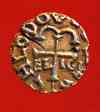
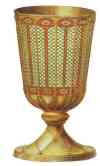
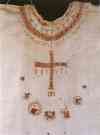
Regions located south of the river Loire were only gradually incorporated into the Merovingian kingdoms during the 6th century. First was Aquitania, up till then governed by the Visigoths, in 507; then territories located between the Langres Plateau and the river Durance, earlier ruled by the Burgundians; finally, in 536, Provence was annexed, which since Theodoric’s reign had first been Visigothic, then Ostrogothic. In these regions, Germanic influence was nearly negligible, while late-Roman civilization kept slowly evolving. Prominent landowners, heirs of ancient Gallo-Roman and sometimes Burgundian aristocrats, continued to monopolize most of the civil magistratures. The use of written contracts was still frequent. Most of the time, the dead were buried in sarcophagi, without grave goods or with very minimal ones.
Aquitanian and Burgundian origins were evident from belt-fittings of certain types, which were also dispersed and imitated in northern Gaul. Aquitains and Provençals probably appeared as foreigners, because of their costume as well as their language, to the inhabitants of northern Gaul, where many words of Germanic origin had been adopted and where Latin already contained many characteristics of medieval northern French.
Bibliographie:
E. Ewig, Die Merowinger und das Frankenreich (Urban Taschenbücher, 1988). - Die Franken, Les Francs (Mainz, Verlag Philipp von Zabern, 1996). - S. Lebecq, Les origines franques Vè-IXè siècle (Points, Histoire, Paris, 1990).- E. James, The Franks (Oxford1988).- P. Périn G.Duchet-Suchaux, Clovis et les Mérovingiens (Tallandier, Historia, 2002).- P. Périn L.C. Feffer, Les Francs (2 vol. Paris, Armand Colin, 1987 et réédition en un seul volume 1997). - F. Vallet, De Clovis à Dagobert: les Mérovingiens (Découvertes Gallimard, 1995). - K.F. Werner, Les Origines, tome 1 de l'histoire de France sous la direction de J.Favier, 1984. - I. Wood, The Merovingian Kingdoms 450-751 (Longman, London and New-York, 1994).